
Datagraphic donates football sponsorship as part of social value strategy
Read More ›


Updated: December 2025
This guide has been refreshed with the latest insights, tools, and best practices for modern customer communications management (CCM), helping you deliver effective, multi-channel customer interactions while staying on budget.
Exploring what CCM is, what it involves and the tools you can use to do it well on a budget.
Customer interactions define how a modern customer experiences your organisation over the long term. Every message, whether delivered in real-time, via email, SMS, or mail, shapes customer expectations and determines the effectiveness of your customer communications.
Today, customers expect clear, timely information delivered through their preferred channels. Meeting those expectations consistently is difficult when legacy systems and manual processes limit visibility, control and speed. That’s why organisations are turning to modern CCM solutions to simplify communication, improve engagement and reduce cost.
Customer Communications Management (CCM) provides a practical framework for delivering accurate, compliant and effective customer communications at scale. In this guide, we explain what CCM is, what it involves, and how Datagraphic’s Aceni platform helps organisations deliver modern customer communications, even when budgets are tight.
By definition:
CCM is the plan, and process organisations follow to produce, deliver, store and retrieve outbound customer communications. It involves using centralised systems to interact with customers in digital formats, such as email, web pages, Short Message Service (SMS) texts, or Chat. And through physical documents, you print and send them by post.
Customer Communications Management (or CCM) is about managing customer communications. But the key is to understand what that ‘management’ should look like. And, if you’re trying to make CCM improvements on a budget, the tools that make that possible.
A good Customer Communications Management plan connects people and processes to the system, tools or platform that manages outbound communications. CCM is successful if it delivers a great customer experience (CX), which increases customer interactions, profitability and loyalty, and makes servicing customers easier and more effective for staff.
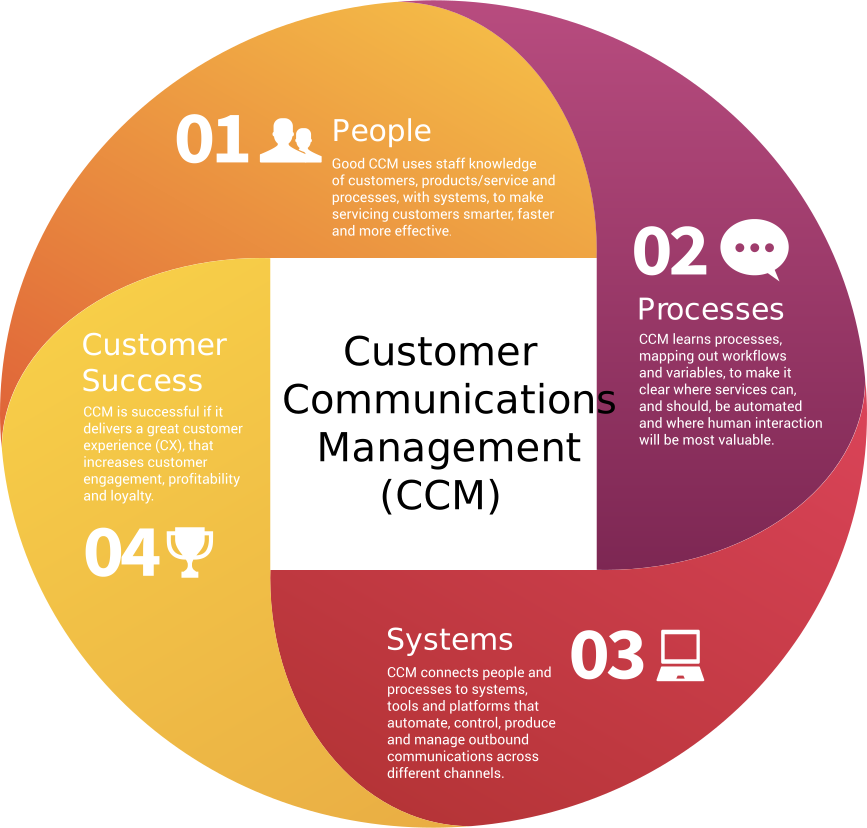
It’s often thought that Customer Communications Management is only for marketing and customer service teams. However, great CCM plans recognise that all customer-facing employees contribute to the customer experience, including finance, sales, and front-line service delivery.
Here’s some example communications teams send at different stages of a customer journey:
On-boarding: Welcome communications, new account introductions, membership benefits, reward options, direct debit mandates or account opening notifications.
Purchasing: Order confirmations, invoices, statements, terms and conditions, renewal and payment notifications.
Retention: Product introductions, appointment confirmations, reward statements.
These examples are by no means a full list: there are more examples in our A-Z of documents article. However, you can begin to understand the various communications an individual customer may receive and the potential for improving customer experience.
New organisations use modern CCM technology from day one, with excellent customer experience built in. Established organisations may have older systems that are harder to adapt, which can compromise customer expectations and outbound communications.
Every customer wants to receive information in their preferred channels, such as email, web pages, SMS, or physical documents. Modern CCM solutions ensure choice and consistency, improving customer engagement and satisfaction.
CCM tools that deliver communications via many channels, and at different times, provide more opportunities for customers to engage with your information.
Traditional approach without CCM tools
Example: A life insurance customer signs up for monthly payments via direct debit. PDFs are blocked by the email service, payments fail, and staff spend significant time recovering income.
Using a CCM platform for multi-channel communications
Example: Customers select preferred channels during signup. Bills are uploaded to a portal, with email and SMS notifications in real time. Payments succeed, CX improves, and staff interaction is minimal.
Incorrect communications damage CX and brand loyalty. Modern CCM platforms automate processes, add quality controls, and minimise human or system errors.
Compliance and legal requirements drive many communications. Good CCM ensures that production and delivery are scalable, even during disruptions or peak demand periods.

Engage with your teams to understand the communications they send and where CX is compromised. Survey customers to understand preferred channels and expectations. Once you know the types of documents, quantities, and channels, speak to one of Datagraphic’s experts.
CCM software is comprehensive but can take years to deliver ROI. Many tools require IT resources, training, and separate delivery services. Datagraphic experts can advise if CCM software is right, or suggest an alternative like Aceni.
Aceni is Datagraphic’s cloud-based CCM platform that works with your existing systems. It delivers communications in digital and physical formats, hosts secure eDocument portals, automates workflows, applies quality controls, and scales from single letters to millions of communications.
Aceni is affordable with pay-as-you-use pricing. You can pilot in a single department or switch organisation-wide at your own pace.
| Approach | Best For | Pros | Cons |
|---|---|---|---|
| Manual / Legacy Systems | Small teams | Low cost | Time-consuming, error-prone, limited scalability |
| Modern CCM Solutions (like Aceni) | Medium to large organisations | Multi-channel, real-time, scalable, improves CX, works with existing systems, pay-as-you-use pricing | Minor learning curve to set up automation rules |
| Hybrid Approach | Growing organisations | Flexible, budget-friendly, can leverage existing systems | May require multiple tools for niche channels |
CCM is the structured approach to producing, delivering, and managing customer communications. It improves customer interactions, ensures compliance, and drives engagement over the long term.
By using preferred channels, delivering messages in real time, and automating processes, CCM ensures customers receive timely, accurate, and relevant communications at every stage of their journey.
Yes — solutions like Aceni work with existing systems, allowing organisations to deliver effective communications without significant upfront investment.
Email, SMS, web portals, chat, and physical documents remain important. The choice depends on customer preferences and the type of communication.
Modern platforms automate alerts, notifications, and reminders, ensuring customers receive timely messages through their preferred channels, enhancing engagement and satisfaction.
Understanding Customer Communications Management (CCM) and implementing the right people, systems, and processes is key to delivering a great customer experience. Platforms like Aceni allow organisations to improve customer interactions, engagement, and efficiency without huge upfront costs. Results can be achieved at your pace, in weeks and months, not years.
Connect with a Datagraphic expert today for a free short demonstration.