
Datagraphic donates football sponsorship as part of social value strategy
Read More ›


When most organisations talk about their sustainability strategy, the conversation almost always begins with decarbonisation.
Net zero targets, renewable energy, waste reduction and emissions reporting have become the defining shape of sustainability programmes. They are important priorities, and environmental performance should absolutely be a key focus for any responsible business.
But sustainability is more than solely an environmental concept.
In fact, some of the most significant risks and opportunities facing businesses today sit beyond carbon accounting. Through a materiality assessment, organisations can identify the environmental, social, and governance issues that matter most to both their stakeholders and long-term success. How organisations treat their employees, govern their operations, manage their supply chains, and uphold ethical standards can have just as much impact on long-term resilience and stakeholder trust as their environmental performance.
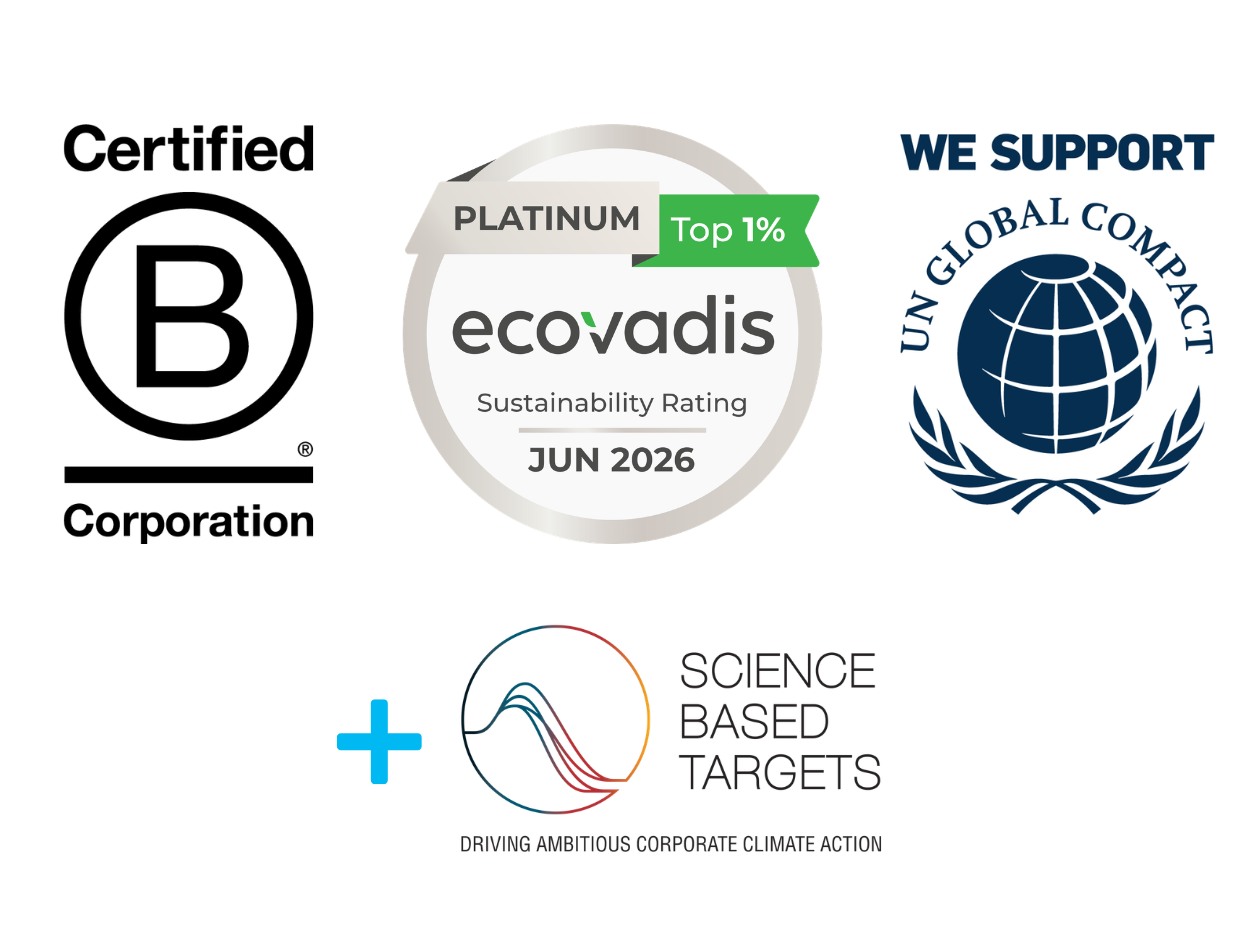
As Datagraphic holds EcoVadis Platinum status, contributing to our Triple Lock+ framework alongside B Corp, the UN Global Compact and the Science Based Targets initiative (SBTi), it is an opportunity to reflect on a broader question:
Is sustainability too narrowly focused on the environment?
Today’s sustainability agenda centres on the concept of balancing economic prosperity, environmental protection and social wellbeing.
Yet environmental metrics are often the most visible, easiest to quantify and most frequently reported. Carbon emissions can be measured, energy consumption can be tracked, and waste can be counted.
It is much harder to measure trust, culture, ethical leadership or employee wellbeing.
As a result, these critical dimensions of sustainability can receive less attention despite playing a fundamental role in organisational success – particularly in an independent assessment such as EcoVadis.
A business cannot claim to be truly sustainable if it achieves environmental targets while overlooking employee welfare, ethical conduct or responsible governance.
The strongest organisations recognise that sustainability is not simply about reducing negative environmental impact; it is about creating positive outcomes across all aspects of business.
Every organisation depends on people. At Datagraphic, we consider our team to be our biggest asset.
Employees, customers, suppliers and communities all contribute to business success, yet discussions about sustainability can sometimes overlook the human element.
Creating a sustainable organisation means creating an environment where people can thrive.
This includes:
These factors influence employee engagement, innovation, retention and organisational resilience. Stakeholders want to know not only what companies produce, but how they treat the people who help produce it.
That expectation is reflected across the frameworks, such as B Corp, the UN Global Compact and EcoVadis, all of which place significant emphasis on social responsibility and labour practices.
Trust is one of the most valuable assets a business can build.
It is earned through consistent ethical behaviour, transparent decision-making and accountability.
Ethics in business extends far beyond compliance. It includes:
In an increasingly connected world, ethical failures can rapidly undermine reputation and stakeholder confidence.
Conversely, organisations that embed ethics into their culture are often better positioned to build lasting relationships with customers, employees and partners. Sustainability without ethics is ultimately unsustainable.
Many organisations publish their sustainability strategy with ambitions, reports and progress updates. Far fewer have the governance structures necessary to deliver them consistently.
Good governance provides the framework that turns aspirations into measurable outcomes. Our Triple Lock+ approach establishes accountability, ensures transparency and creates mechanisms for continuous improvement.
Strong governance helps organisations:
Without effective governance, even the most ambitious sustainability strategies can lose momentum.
This is why governance forms a core pillar of leading sustainability frameworks and assessments. It provides confidence that commitments are supported by systems, leadership and oversight.
One of the challenges businesses face is demonstrating that their sustainability efforts are credible. With organisations ‘greenwashing’ to create ambiguous PR claims, stakeholders increasingly expect evidence, not simply claims.
This is where independent assessments play a critical role.
Frameworks such as B Corp, the UN Global Compact, SBTi and EcoVadis evaluate different aspects of organisational performance, providing external validation of both commitments and actions.
Together, these accreditations create a more complete picture of sustainability performance to help organisations move beyond compliance and towards meaningful, measurable impact.
Carbon will remain a critical issue for businesses and society, and quite rightly.
But if sustainability conversations focus exclusively on environmental metrics, organisations risk overlooking some of the very factors that determine whether positive change can be achieved and sustained.
People create culture.
Ethics build trust.
Governance drives accountability.
These are not secondary considerations – they are foundational pillars of sustainable operations. Not simply as an environmental strategy, but as a commitment to responsible business across every part of the organisation.
Find out more about Datagraphic’s sustainability strategy.